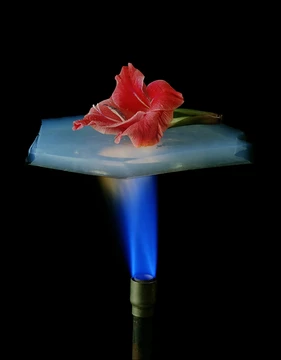
Collision frequency
Rate of collisions between atomic or molecular species per unit time.

Collision frequency describes the rate of collisions between two atomic or molecular species in a given volume, per unit time. In an ideal gas, assuming hard-sphere behavior, the collision frequency is given by a formula involving the number of particles, collision cross section, Boltzmann constant, temperature, and reduced mass. For diluted solutions, a separate expression relates collision frequency to viscosity and number density, independent of particle size for equal-size particles.
- field
- Kinetic theory of gases, chemical kinetics
- known_for
- Quantifying collision rates between particles in gases and solutions
Lore & Background
Collision frequency is a central concept in the kinetic theory of gases and chemical kinetics. For an ideal gas with hard-sphere particles, the collision frequency Z between species A and B is calculated as Z = N_A N_B σ_AB √(8k_B T / (π μ_AB)), where N_A and N_B are particle numbers, σ_AB is the collision cross section (for hard spheres, σ_AB = π(r_A + r_B)^2), k_B is the Boltzmann constant, T is temperature, and μ_AB is the reduced mass. This expression accounts for the effective area and relative motion of colliding particles.
Reader's Guide
In diluted solutions, for equal-size particles at concentration n in a solution of viscosity η, the collision frequency per second ν is given by ν = (8k_B T)/(3η) n, where the frequency is independent of particle size—a result noted as counter-intuitive. For particles of different sizes, more elaborate expressions can be derived. Collision frequency is fundamental to understanding reaction rates in gases and liquids, as it provides the maximum possible number of collisions under given conditions, though not all collisions lead to reactions.
Did You Know?
- For hard spheres, the collision cross section σ_AB equals π times the square of the sum of the radii of the two species.
- In diluted solution with equal-size particles, collision frequency per second is independent of particle size.
- The reduced mass μ_AB is defined as (m_A m_B)/(m_A + m_B).
- The formula for collision frequency in an ideal gas includes the square root of (8k_B T)/(π μ_AB).
Frequently Asked Questions
Who is Collision frequency?
Collision frequency is a rate quantity in kinetic theory that tells you how many times two different kinds of atoms or molecules strike one another inside a defined volume over a set interval. Rather than describing a single event, it captures the ongoing statistical pace of encounters between particle species.
What are Collision frequency's powers or role?
Its central job is to translate microscopic particle properties—number density, effective collision cross section, temperature, and reduced mass—into a single number: the number of pairwise encounters per unit time. In diluted solutions a parallel expression swaps in the medium's viscosity and number density, and for equal-sized particles the size dependence drops out entirely.
How does Collision frequency's story end (i.e., how is it expressed)?
For a hard-sphere ideal gas the working formula multiplies the relevant particle count by the cross section and a thermal-speed factor built from the Boltzmann constant, temperature, and reduced mass of the pair. In solution the analogous relation ties the rate to viscosity and number density, giving a distinct but equally predictive result.
Why is Collision frequency important to the field?
Every elementary chemical step in a gas or liquid must begin with a physical encounter between reactants, so the collision rate sets the upper bound on how fast a reaction can proceed. It is therefore the bridge between statistical mechanics and the observable rate laws of chemical kinetics.
What universe or subfield does Collision frequency belong to?
It is a staple of the kinetic theory of gases and of chemical kinetics, appearing in both gas-phase and solution-phase treatments of molecular interactions. Its definitions shift slightly between the hard-sphere gas model and the viscous-solution model, but the underlying purpose—counting encounters per unit time—stays the same.
More in Physical Chemistry And Thermodynamics 1-20
Spotted an error? Know more?
This is a living reference — every entry is fact-audited, and reader corrections feed straight into our audit queue. Suggest an edit · See this site's audit record